 EN
EN
 中文
中文 English
 Pусский
 Français
 Español
It often begins with a minor, puzzling event. A motor control centre trips for no obvious reason, a section of a distribution board runs noticeably warmer than the one next to it, or an infrared scan picks up a hot spot that wasn’t there during the last inspection. Technicians start by checking breakers, cables, and connections. When everything tests fine, the focus shifts to something that is supposed to be completely passive: the insulating components that separate and support live parts. Far too often, these parts have degraded to a point where they can no longer do their job, even though they are only a fraction of the way through their expected service life. The financial ripple effect — emergency call-outs, production stoppages, and damage to adjacent equipment — consistently outweighs the cost of preventing the problem in the first place.
Understanding the failure mechanisms
Insulation in low-voltage assemblies rarely fails because of a single dramatic event. It gives way gradually, worn down by a combination of electrical, environmental, and mechanical factors that act together over months and years.
The most aggressive of these is surface tracking. Even at low voltages, a potential difference across an insulating surface drives tiny leakage currents. When dust, moisture, or salt spray settles on the surface, those currents concentrate and create localised hot spots. The heat carbonises the polymer, forming conductive paths. Once a carbon track takes hold, the surface resistance plummets, the leakage current rises, and the deterioration accelerates. A component that looked intact a few months earlier can become a conductive bridge between phases, leading to a flashover. This mechanism is especially ruthless in facilities near the coast or in industries where conductive dust is part of the normal environment. In one coastal workshop, busbar supports made from a general-purpose plastic developed visible tracking marks within eighteen months simply because the material’s Comparative Tracking Index (CTI) was below 200 V — far less than the 400 V minimum that IEC 60664-1 advises for polluted conditions.
Thermal cycling is the second persistent threat. Every load change swings the temperature of busbars and the insulating supports that hold them. The metal expands and contracts, and the rigidly bolted insulating parts must follow. Over hundreds of cycles, this repeated micro-movement generates mechanical creep, which can initiate hairline cracks. Once a crack forms, moisture enters, and partial discharge begins to erode the material from the inside out. A common but avoidable installation mistake compounds this stress: applying too much torque to the mounting bolts. The belief that “tighter is safer” often leads to bolt heads sinking into the polymer, creating stress risers. Field reports describe insulating bases that snapped cleanly around the bolt hole after less than two years of operation because the installation torque was more than double the manufacturer’s recommendation.
Material selection: the first line of defence
Preventing early failures starts long before the first bolt is tightened. It begins with the material specification. Not all insulating materials are created equal, and the right choice is dictated by the environment the assembly will actually face.
Glass-fibre reinforced polyester moulding compounds, such as BMC and SMC, have become the benchmark for demanding low-voltage applications. They combine high mechanical strength with CTI values that routinely exceed 500 V, and they carry an inherent flame resistance that meets UL 94 V-0 requirements. By contrast, general-purpose thermoplastics are only suitable for clean, dry, and thermally stable indoor settings — conditions that rarely describe real industrial or infrastructure environments. Melamine and phenolic compounds offer decent tracking resistance but tend to be more brittle, making them less forgiving of mechanical misalignment.
When specifying insulation, looking beyond the initial purchase price is essential. The difference in cost between a standard component and one with a certified high CTI and verified creepage compliance is marginal compared to the expense of a single unplanned outage. Where the operating environment introduces even moderate contamination, choosing components with proven high tracking resistance eliminates a root cause that is otherwise guaranteed to resurface. It is a specification decision that protects not just the insulating part itself, but every conductor and device that sits around it.
Installation and maintenance practices that prevent premature aging
Even the most carefully chosen material will fail early if it is mounted incorrectly or ignored during routine maintenance. The good news is that preventing installation-induced failures requires only a few disciplined habits.
Torque control is non-negotiable. Always use a calibrated torque wrench set to the value provided by the manufacturer, never an impact driver. Equally important is the flatness of the mounting surface; a bowed DIN rail or an uneven panel frame pre-loads the insulator in bending, a loading mode for which it was never designed. Panel builders who implement a simple torque reference card for the most common fastener sizes typically see a sharp drop in stress-related insulator damage. Adopting the recommended mounting practices for insulating components — torque discipline, flatness checks, and visual inspection after tightening — is one of the most effective steps a workshop can take.
Thermal imaging must become a scheduled preventive activity, not just a reactive tool. An infrared camera can reveal a slowly warming insulator months before it produces a smell or a trip. A temperature differential of only 10 °C above identical adjacent units is often the first sign of early tracking or a high-resistance contact overheating the polymer. When combined with regular cleaning to remove conductive dust and salt deposits, thermal imaging provides a reliable early warning system. A soft, dry cloth or a cleaner approved by the material supplier is usually sufficient to keep surfaces free of the electrolytic film that encourages tracking.
Maintenance crews also need to know what to look for during visual inspections. Surface erosion, dull frosted patches, tree-like carbon patterns, or small pinholes all signal that tracking is underway. When a low-voltage insulator shows these symptoms, replacing it immediately is only half the job; the conditions that caused the degradation — moisture ingress, an inadequate CTI, or chronic contamination — must be corrected as well. Otherwise, the replacement part will follow the same failure curve.
From reactive fixes to a planned upgrade strategy
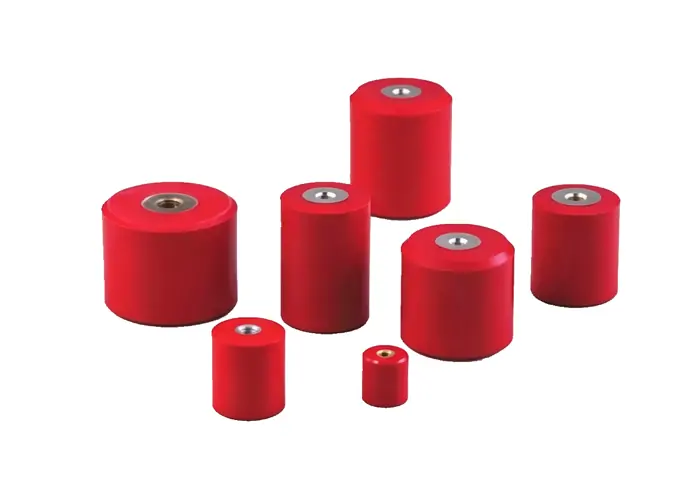
Many ageing electrical installations are still fitted with insulating components designed to standards that are now decades out of date. Since then, material science has delivered dramatic improvements in tracking resistance, moisture absorption, and thermal endurance. For facilities that are already spending too much on corrective maintenance or suffering from unexplained trips, a planned upgrade program that replaces legacy insulating supports with modern grades often pays for itself in a single avoided failure. The decision to upgrade to advanced glass-fibre reinforced polyester supports turns a recurring maintenance headache into a predictable, low-risk operation.
This approach consistently extends the life of low-voltage insulators in demanding settings, but it only works when the new parts are installed with the same care described earlier. An upgrade is not just a material swap; it is an opportunity to reset installation practices, tighten thermal monitoring routines, and train the team to distinguish normal ageing from abnormal degradation.
A smarter way to long-term reliability
Premature insulation failure in low-voltage equipment is almost never a one-factor event. It is the intersection of a material that was not quite right for its environment, an installation step that introduced unintended stress, and a maintenance routine that did not catch the early warning signs. Treating it as a system problem, rather than a component problem, changes the outcome completely.
Start with a clear specification that reflects the real operating environment — one that sets minimum CTI values, flame ratings, and mechanical requirements. Translate that into a procurement standard that demands verifiable compliance with IEC 60664-1 and IEC 61439. On the shop floor, enforce torque control and schedule thermal imaging. Train the team so that they can spot a developing tracking pattern before it becomes a trip. These steps are not theoretical; they are practised by organisations that have successfully moved from a reactive fix-on-fail cycle to a condition-based maintenance model.
If the goal is to reduce unplanned downtime and take the guesswork out of insulation performance, it helps to start with components that are explicitly designed for the challenge. CHUNDEXIN offers a focused range of insulation solutions engineered to resist tracking, endure mechanical stress, and simplify installation in low-voltage assemblies. Explore CHUNDEXIN’s full catalogue of insulation solutions to identify models that match your application’s creepage distance and CTI requirements.
Disclaimer: This article provides general guidance and is not a substitute for a site-specific engineering evaluation. Always refer to applicable local codes, manufacturer specifications, and qualified engineering professionals when selecting or maintaining electrical insulation components.