 EN
EN
 中文
中文 English
 Pусский
 Français
 Español
Medium‑voltage cable jointing has traditionally been a field‑intensive process. Heat‑shrink and cold‑shrink technologies, widely used for decades, require skilled installers working in conditions that are often less than ideal – damp trenches, dusty switchgear rooms, or elevated platforms with limited access. The quality of the finished joint depends on surface preparation, consistent heating (for heat‑shrink), and freedom from contamination. Even small errors can introduce partial discharge activity that goes undetected until a fault occurs years later.
These challenges are well documented across the electrical industry, and the direction of product development in 2026 reflects a deliberate effort to reduce field variability, improve material performance, and bring joint condition into the monitoring systems that already oversee transformers and switchgear. Three trends are now visible across the portfolios of major manufacturers and in the technical programs of industry events such as CIGRE and IEEE PES conferences.
Trend 1: Prefabricated Joints Moving from Niche to Standard
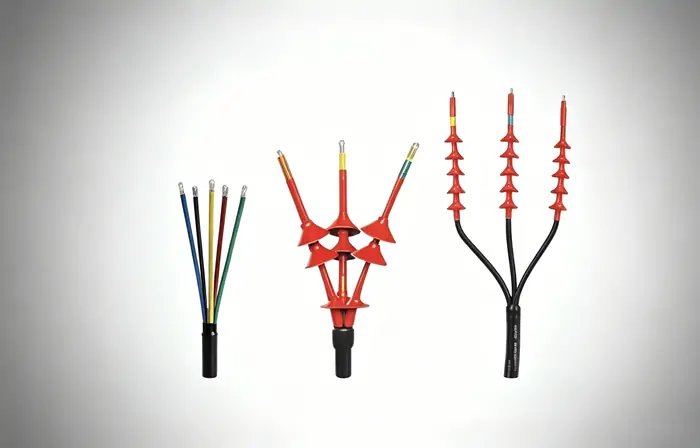
Prefabricated joints – also called push‑on or slip‑on joints – are not a new invention, but their share of the medium‑voltage accessories market is growing. Unlike heat‑shrink systems, which build up an insulation layer by layer in the field, prefabricated joints have the insulation body, conductive deflector, and stress control geometry moulded as a single unit in a factory. Installation becomes a mechanical assembly process: prepare the cable, lubricate, and push the joint body into position.
The primary driver is reliability and repeatability. Factory moulding under controlled conditions produces a joint body with fewer internal defects – voids, inclusions, or interfacial irregularities – than can typically be achieved in the field. Industry testing reported in CIGRE Technical Brochure 560 showed that properly installed prefabricated joints have statistically lower partial discharge levels at commissioning compared to field‑assembled heat‑shrink joints.
A secondary driver is installation speed. Cable jointers report that a prefabricated joint can be installed in roughly half the time of an equivalent heat‑shrink joint for cross‑sections up to 300 mm². This time saving is particularly relevant for emergency repairs and for renewable energy projects where multiple turbine or solar array connections need to be completed within tight construction windows.
For operations teams planning new builds or refurbishments in 2026, it is worth evaluating factory‑prefabricated silicone joint bodies for medium‑voltage cable connections. The material and design choices made at the specification stage determine whether field teams spend hours building joints layer by layer or push on a tested, ready‑made assembly.
Trend 2: Silicone Insulation Gaining Ground
Ethylene‑propylene rubber has been the dominant material for cold‑shrink and prefabricated joints for many years. Silicone rubber is now taking a larger share, particularly in applications where environmental exposure is a concern.
Silicone offers several technical advantages that are becoming better understood in the user community:
-
Hydrophobicity. Silicone surfaces repel water, and, critically, low‑molecular‑weight silicone oils migrate to the surface over time, encapsulating surface contaminants and maintaining hydrophobicity even after exposure to pollution or salt fog. This is documented in IEC 60815 for outdoor insulation selection.
-
Wide operating temperature range. Silicone retains flexibility and electrical properties from approximately -50°C to +150°C (continuous), making it suitable for both cold-climate installations and high‑temperature environments near industrial equipment.
-
Tracking and erosion resistance. Silicone compounds formulated for high‑voltage applications achieve high performance in the inclined plane test per IEC 60587, an indicator of long‑term resistance to surface discharge activity.
The trade‑off historically has been lower tear strength compared to EPDM, which required careful handling during installation. Modern silicone formulations have narrowed this gap significantly, and many manufacturers now offer silicone joint bodies rated for the same mechanical handling as their EPDM equivalents.
For utility engineers and industrial end‑users specifying joints for coastal, polluted, or high‑humidity environments, the shift toward silicone‑insulated joint and termination products with proven tracking resistance reflects a growing industry consensus that the material’s long‑term surface performance outweighs the marginal cost increase.
Trend 3: Smart Monitoring Integration
The third trend is the slow but steady integration of condition monitoring into cable accessories themselves. Traditionally, underground cable joints have been invisible assets – buried, inaccessible, and inspected only when a fault occurs.
That picture is beginning to change. Partial discharge sensors, temperature sensors (either fiber‑optic or wireless surface‑mount), and humidity detectors are being embedded into joint bodies or installed adjacent to joints during construction. The data is fed into the same SCADA or asset management platforms that monitor transformers, circuit breakers, and overhead lines.
Several developments are pushing this trend forward:
-
Standards development. IEC TC 20 (Electric Cables) has ongoing work on guidelines for integrating monitoring into cable systems, reflecting industry demand for standardised approaches rather than proprietary black boxes.
-
Cost reduction in sensor hardware. Surface acoustic wave temperature sensors and Rogowski‑coil partial discharge sensors have become smaller and less expensive, making distributed monitoring economically viable for networks that would not have considered it five years ago.
-
Practical experience from pilot projects. Distribution network operators in Europe and parts of Asia have published results from pilot installations where embedded partial discharge monitoring in joints detected developing faults months before they would have caused an outage, allowing planned maintenance rather than emergency repair.
At the 2024 CIGRE Session, papers from several European utilities reported that continuous partial discharge monitoring at cable joints had reduced unplanned outages on critical feeders by enabling condition‑based replacement programs. For operators looking to integrate accessories into broader asset management strategies, cold‑shrink and prefabricated joint systems compatible with sensor integration are an area of active product development in 2026.
What These Trends Mean for Specification in 2026
Project engineers planning cable installations this year can take several practical steps in response to these trends:
-
For new medium‑voltage networks, evaluate whether prefabricated joints can replace heat‑shrink in at least the standard cross‑section and voltage combinations. The time savings in construction are real, and the repeatability advantage is supported by published test data.
-
For installations in harsh environments, review whether silicone insulation offers a longer service life than the currently specified material. The incremental cost is typically small relative to the cost of a joint failure and associated outage.
-
For critical feeder circuits, consider specifying joints with sensor access, even if the monitoring system is not deployed immediately. The marginal cost of a sensor‑ready joint is modest, and it preserves the option to add monitoring later without excavation.
-
For procurement teams, ask potential suppliers for test reports that demonstrate partial discharge performance at commissioning (below 10 pC at 2U₀ is the commonly referenced acceptance level), tracking resistance per IEC 60587, and, where relevant, evidence of sensor integration from completed projects.
These trends are not theoretical – they are visible in product catalogues, conference proceedings, and the procurement specifications of forward‑leaning distribution utilities. The common thread is a move away from treating cable joints as passive, field‑assembled components and toward factory‑engineered, monitorable system elements.
For teams who want to see how these technology shifts are reflected in a current product range, Chundexin’s portfolio of cable connection and insulation components covers cold‑shrink, heat‑shrink, and prefabricated options for medium‑voltage applications, with detailed specifications that allow meaningful comparison against the criteria discussed above.