 EN
EN
 中文
中文 English
 Pусский
 Français
 Español
A single weak point in a transmission network can trigger far more than a localised outage. In recent years, utilities across Asia, Europe, and North America have faced increasing pressure from extreme weather, rising electricity demand, renewable energy integration, and ageing infrastructure. The result? Transmission reliability has become one of the most discussed topics in the power industry.
Yet when engineers investigate line failures, contamination flashovers, or unexpected shutdowns, the issue often traces back to a component many people rarely notice: the insulation system supporting high-voltage conductors.
The Growing Stress on Modern Transmission Networks
Transmission lines today operate under harsher conditions than they did a decade ago. Rapid urban expansion has increased airborne pollutants, coastal projects expose equipment to salt fog corrosion, and renewable energy installations frequently require longer-distance transmission routes.
According to the International Energy Agency (IEA), global electricity demand is expected to continue rising steadily through 2030, especially due to electrification and data centre growth. Utilities are therefore upgrading substations and transmission corridors faster than ever.
But expansion alone is not enough. Reliability under difficult environmental conditions has become the real challenge.
Common operational risks include:
•Surface contamination is causing leakage current
•UV ageing from prolonged sun exposure
•Ice accumulation and mechanical stress
•Salt fog corrosion in coastal regions
•Sudden temperature fluctuation leading to material fatigue
In many utility maintenance reports, insulation degradation appears repeatedly as a contributing factor behind unexpected outages.
Why Material Selection Has Become a Strategic Decision
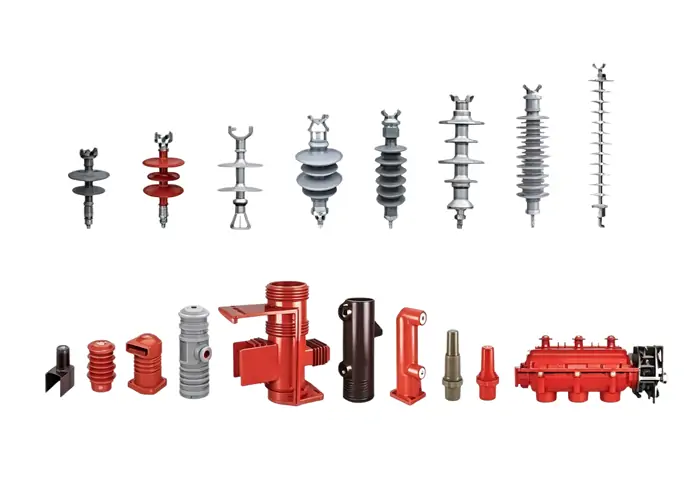
Years ago, many transmission projects relied heavily on porcelain components because of their mechanical strength and established manufacturing processes. However, modern grid operators are increasingly shifting toward lighter polymer-based alternatives for specific environments.
The reason is simple: operating conditions have changed.
Composite materials offer several practical advantages in heavily polluted or high-humidity regions:
| Comparison Factor | Traditional Ceramic Designs | Modern Composite Alternatives |
| Weight | Moderate | Lightweight |
| Pollution Resistance | Higher | Strong |
| Installation Difficulty | Higher | Lower |
| Maintenance Frequency | More Frequent Cleaning | Reduced Cleaning Needs |
| Impact Resistance | Brittle Under Shock | Better Flexibility |
Utilities working in coastal areas or industrial zones often prioritise hydrophobic surface performance because it helps reduce contamination-related flashovers during wet weather conditions.
For engineers evaluating long-term outdoor reliability, reviewing different material structures and weather-resistant designs can provide a clearer understanding of suitable configurations for demanding environments.
Environmental Pollution Is Changing Maintenance Strategies
One of the biggest shifts in recent years is the move from reactive maintenance to predictive maintenance.
Instead of waiting for visible damage, many utilities now use infrared inspection, leakage current monitoring, and drone-based diagnostics to identify early warning signs.
This change happened because contamination-related failures are expensive — not only in repair costs, but also in downtime and grid instability.
Industrial pollution, desert dust, and coastal salt deposits can gradually form conductive layers on exposed surfaces. Under humid conditions, these deposits may trigger partial discharge or flashover events.
To minimise risk, operators increasingly look for designs featuring:
•Enhanced creepage distance
•Superior hydrophobicity
•UV-resistant silicone housing
•Corrosion-resistant fittings
•Long-term mechanical stability
IEEE and IEC standards also continue evolving to address harsher service environments and higher voltage demands.
Renewable Energy Expansion Is Creating New Challenges
Renewable energy projects are accelerating the need for more durable transmission infrastructure.
Large-scale solar farms and wind power facilities are often located far from population centres, requiring ultra-long-distance power transmission. These routes frequently cross deserts, mountains, coastal areas, or regions with severe weather exposure.
That creates unique engineering challenges.
For example:
•Wind farms near coastlines face continuous salt mist exposure
•Desert solar installations deal with dust contamination and UV stress
•Mountain transmission routes experience ice loading and rapid temperature swings
In these environments, maintenance access can be difficult and expensive. Utilities, therefore, prioritise components with lower lifecycle maintenance requirements.
Some project managers now evaluate suppliers not only on product specifications, but also on:
•Third-party testing documentation
•Long-term ageing performance
•Manufacturing consistency
•Compliance with IEC and ANSI standards
•Delivery capability for large infrastructure projects
Projects operating in harsh outdoor environments often require careful evaluation of contamination resistance, mechanical strength, and long-term weather durability before equipment selection begins.
Reliability Is No Longer Just an Engineering Issue
Power reliability now directly affects economic stability.
Data centres, semiconductor manufacturing plants, transportation systems, and hospitals all depend on an uninterrupted electricity supply. Even short disruptions can create significant financial losses.
This is why utilities increasingly focus on lifecycle cost rather than only upfront procurement pricing.
A cheaper component that requires frequent maintenance may ultimately become far more expensive over a 20-year service life.
Experienced procurement teams often evaluate:
•Failure rate history
•Weather resistance
•Installation efficiency
•Inspection requirements
•Expected service lifespan
This lifecycle-based procurement approach is becoming standard practice in modern infrastructure planning.
How Manufacturers Are Responding to Higher Industry Expectations
Manufacturers serving the transmission sector are also adapting quickly.
Today’s buyers expect:
•Automated quality inspection
•Traceable raw materials
•Consistent dimensional accuracy
•Compliance with international testing standards
•Faster customisation capability
Some factories have invested heavily in automated moulding systems, advanced silicone formulation technologies, and stricter high-voltage testing procedures to meet utility-grade expectations.
For procurement teams comparing suppliers, technical support capability is becoming nearly as important as the product itself.
This includes:
•Application guidance
•Environmental suitability recommendations
•Custom dimensional support
•Certification documentation
•Logistics coordination for international projects
Companies like Chundexin have increasingly focused on providing application-oriented solutions for transmission infrastructure projects that require stable, long-term outdoor performance.
Looking Ahead: Grid Stability Depends on Small Details
As transmission networks become more complex, small component failures can have wider consequences than ever before.
Grid modernisation is not only about smart systems, AI monitoring, or renewable energy integration. It also depends on whether every supporting component can maintain stable performance under years of environmental stress.
That is why utilities worldwide are paying closer attention to insulation design, contamination resistance, and long-term durability.
The industry conversation has shifted from simply “meeting voltage requirements” to ensuring long-term operational resilience.
For engineers, EPC contractors, and utility procurement teams seeking more reliable outdoor transmission solutions, understanding material behaviour and environmental suitability is becoming essential to reducing long-term operational risk.
If you hope to explore more application-focused transmission insulation technologies and outdoor grid reliability solutions, Chundexin provides additional technical information for different environmental and utility scenarios.